

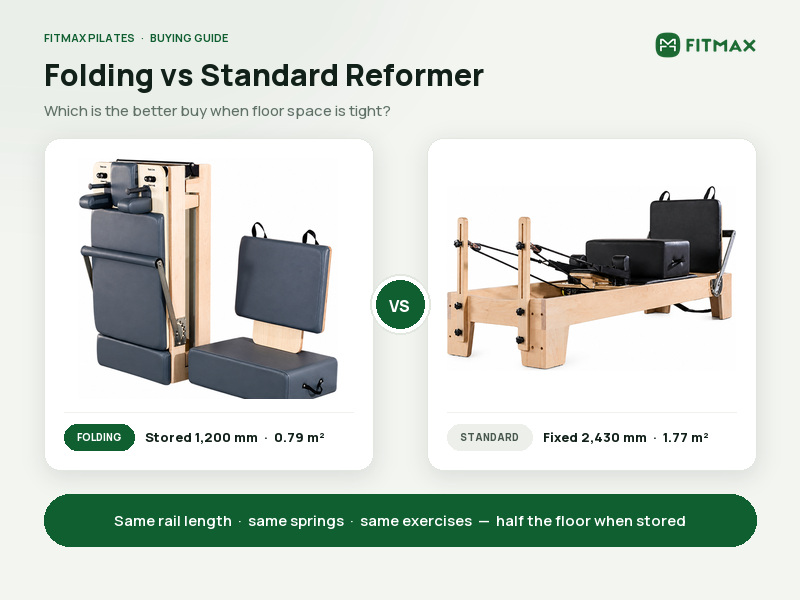
If you are short on space, the honest answer is that a folding reformer is usually the better buy — as long as you understand exactly what the fold costs you. On a folding reformer, the carriage travels the same distance, the springs are the same, and the exercises are the same as on a fixed machine. What changes is where the machine lives when it is not in use. That is the entire trade-off, and it is the only one that matters for most small-space buyers.
This guide compares folding and standard reformers on the specifications you can actually measure — folded dimensions, floor area, rail length, weight, and stability — and then answers the question studio owners and home buyers ask most often: my space is small, so what should I buy?
Quick answer: folding or standard reformer for a small space?
Buy a folding reformer if any of these is true: your room doubles as something else, you rent shared space, you train clients on site, or you have less than about 9 m² to give to equipment. A folding reformer stores in roughly half the floor length of the same machine open — the FitMax Maple Folding Reformer folds from 2,420 mm to 1,200 mm, and the Aluminum Folding Reformer from 2,485 mm to 1,350 mm. Buy a standard reformer if the room belongs to you, runs back-to-back classes, and never needs to be anything else. Folding costs you setup time; a fixed machine costs you permanent floor area. Pick the cost you can live with.
Key takeaways
A folding reformer does not shorten your carriage travel. On FitMax models the folding frame keeps essentially the same rail length as its fixed equivalent.
Folding cuts the stored length by about 46–50% and the stored floor area by roughly half.
The genuine costs of folding are setup time, a hinge mechanism to maintain, and slightly higher weight on some aluminium models.
Folding is not the same as cheap. A folding reformer can carry a higher load rating than a fixed one — check the number, do not assume.
Working clearance is what usually decides your room, not the machine. Plan the clear zone first, then choose the frame.
If you run classes back to back with several units, buy fixed. Folding pays off in shared, rented, or multi-use rooms.
Folding vs standard reformer at a glance
These are measured specifications from the FitMax range. Read the two middle rows first — that is where the decision lives.
| Maple Folding | Aluminum Folding | Maple Standard | Aluminum Standard | |
|---|---|---|---|---|
| Frame material | North American white maple | Aluminium alloy | North American white maple | Aluminium alloy |
| Length in use | 2,420 mm | 2,485 mm | 2,430 mm | 2,445 mm |
| Stored length | 1,200 mm | 1,350 mm | 2,430 mm (no fold) | 2,445 mm (no fold) |
| Width | 680 mm | 695 mm | 730 mm | 695 mm |
| Height | 270 mm | 280 mm | 385 mm | 370 mm |
| Machine weight | 66 kg | 75 kg | 86 kg | 70 kg |
| Load capacity | 200 kg | 300 kg | 200 kg | 300 kg |
| Best for | Premium feel, small studio, home | High traffic, humid climate, colour matching | Dedicated reformer room | Commercial gym floor |
Two things jump out of that table. First, the folding maple model is 20 kg lighter than the standard maple model — folding frames are not automatically heavier. Second, the folding aluminium model keeps a 300 kg load rating, which is higher than either maple machine. Folding is a frame mechanism, not a construction grade.
What folding actually saves you: the space maths
Manufacturers quote folded length because it flatters the number. Floor area is what you actually pay rent on, so work it out properly.
| Folding (maple) | Standard (maple) | |
|---|---|---|
| Footprint in use | 2,420 × 680 mm = 1.65 m² | 2,430 × 730 mm = 1.77 m² |
| Footprint in storage | 1,200 × 655 mm = 0.79 m² | 1.77 m² (unchanged) |
| Floor area released | 0.86 m² per machine | |
| Folded volume | 1,200 × 655 × 370 mm = 0.29 m³ | — |
Half a square metre does not sound dramatic until you multiply it. A room with six reformers releases over 5 m² of usable floor the moment the class ends — enough to run a mat class, a workshop, or a reception area in the same room.
The folded unit is also a manageable package: 1,200 mm long, 655 mm wide and 370 mm high. That clears a standard door opening, fits under a worktop-height shelf, slides into a car boot, and stands in the corner of a room without dominating it. FitMax designs its folding range to store vertically against a wall, which is the configuration that gives you back the most floor.
Does folding compromise the workout? Rail length, travel and stability
This is the fear that stops people buying folding machines, and it is worth answering with numbers rather than reassurance.
Rail length. Compare the two maple models: 2,420 mm folding versus 2,430 mm standard — a difference of 10 mm, or under half a percent. Across the aluminium pair the folding model is actually 40 mm longer than the fixed one. The carriage travels the same distance on both. A fold that costs you 10 mm of rail is not a compromise you will feel on any exercise.
Spring resistance. Springs are independent of the folding mechanism. FitMax fits both folding and fixed models from the same high-tension piano wire spring specification, so resistance range and recalibration behaviour are the same.
Stability. A folding frame introduces a hinge, and a hinge is a stiffness question. What matters is what the manufacturer does about it: whether the frame locks rigid when open, whether the joint sits on a load path that is supported rather than cantilevered, and whether the unit still meets its rated load when open. Ask for the open-state load rating specifically — a rating that only applies when folded would be meaningless. FitMax rates its folding models at 200 kg (maple) and 300 kg (aluminium) in use.
Glide quality. On FitMax machines the carriage runs on precision-aligned rails and rollers designed for silent operation, and the roller set is specified for the frame, not downgraded because the frame folds. Sit on a carriage and push it before you buy. A dragging carriage feels the same whether the frame folds or not, and both are equally disqualifying.
How much space do you actually need?
The machine is rarely the problem. Working clearance is. You need room to mount, dismount, and move around the foot end, plus space for an instructor to stand.
| Space you have | What fits | Best choice |
|---|---|---|
| Under 5 m² (corner of a room, shared flat) | One reformer, stored between sessions | Folding — nothing else works |
| 5–9 m² (spare bedroom, small home studio) | One reformer in use, clear floor recovered after | Folding for versatility; fixed is possible |
| 9–20 m² (private studio, one-to-one room) | 2–3 reformers or one reformer plus tower | Either — choose on scheduling, not space |
| 20–40 m² (small group studio) | 4–6 reformers in a class layout | Fixed, unless the room is shared |
| 40 m²+ (commercial studio, multi-room) | Full class banks | Fixed — setup time becomes the bottleneck |
As a working rule, allow roughly 2.4 m × 0.7 m for the machine itself and about 600–900 mm of clear floor on the working sides and at the foot end. If you are laying out a class, add aisle space between units so an instructor can reach any client without climbing over equipment.
When a folding reformer is the wrong buy
A good salesperson tells you when not to buy. There are three situations where folding is the wrong answer.
You run back-to-back group classes on several units. Folding ten machines between classes costs real minutes, every single time. If the room is yours and the timetable is full, a fixed machine removes that task permanently. Folding is a solution to a space problem you do not have.
The machine will not be moved or stored. If the reformer has a permanent position and nothing else ever needs that floor, the fold is dead weight — an extra mechanism to maintain in exchange for a benefit you never collect.
You need the absolute lowest maintenance surface count. A folding frame has a hinge, a lock, and moving joints that a fixed frame does not. On a high-traffic gym floor where machines are inspected monthly at best, fewer mechanisms is genuinely simpler.
When a standard reformer is the wrong buy
Mirror the argument. A fixed reformer is the wrong choice when the room has to serve another purpose, when you rent by the hour, when you train clients in their own homes, when you demonstrate at trade shows, or when you simply do not have a spare 1.8 m² to dedicate permanently. In all of those cases you are not choosing between two machines — you are choosing between owning a reformer and not owning one. That is the real stake for small-space buyers.
Decide in 60 seconds
Run these in order and stop at the first one that applies.
Does the room need to be used for anything else, ever? → Folding.
Do you rent or share the space? → Folding.
Do you travel to clients or move the machine? → Folding.
Do you have under about 9 m² for equipment? → Folding.
Do you run classes back to back with several units, in a room that is yours? → Standard.
None of the above clearly applies? → Folding. Every exercise works, and the option to reclaim the floor costs you little.
If you go folding: maple or aluminium alloy?
Both folding models in the FitMax range fold to roughly half their working length, and both keep full rail length when open. The difference is the frame and what it suits.
| Maple Folding | Aluminum Folding | |
|---|---|---|
| Weight | 66 kg — lighter, easier for one person | 75 kg |
| Load capacity | 200 kg | 300 kg |
| Look and feel | Warm, traditional, boutique | Sleek, modern, powder-coated |
| Upholstery | Beige synthetic leather, wipe-clean | Microfibre leather, odour-resistant, deep-clean safe |
| Carriage wheels | Precision-aligned rails and rollers | 4 load-bearing + 4 adjustable side wheels |
| Footbar positions | Adjustable multi-level spring resistance | 7 height positions, soft padded |
| Headrest | Included with box and jump board | 3 angles |
| Customisation | Available in a range of colours | 55 leather colours, custom logo |
| Humidity sensitivity | Wood — keep the room reasonably stable | None — suits warm or humid climates |
The deciding question is usually mobility versus headroom. If one person has to move and store the machine alone, the 66 kg maple fold is the easier machine to live with. If you are buying for a humid climate, a commercial floor, or a heavier client base — or you want your own colours and logo — the aluminium fold carries a 300 kg rating and stays out of trouble in conditions that punish wood.
Eight-point checklist before you buy a folding reformer
Open-state rail length. Ask for the length in use, not just the folded figure. This is the number that decides whether the workout is compromised.
Open-state load rating. Confirm the capacity applies when the frame is locked open.
Does it lock rigid? Push down on the foot end and lean on the carriage. Any flex or creak at the hinge is a reason to walk away.
Is there a storage latch? A folded unit that can unfold when nudged is a hazard, not just an annoyance.
Folded dimensions against your real storage. Measure the cupboard, the car boot, the lift, and the doorways before you order.
Weight and who moves it. 66 kg is a two-hand one-person job for most owners; confirm that is acceptable to you.
Parts and spring supply. The hinge, the lock, the wheels, and the springs should all be orderable as spares.
What ships with it. Jump board, box, and headrest are included on the FitMax folding range and each one expands the exercise library — check comparable models rather than assuming.
Frequently asked questions
Is a folding reformer as good as a standard reformer?
For the workout, yes. A folding reformer keeps the same rail length, the same spring specification, and the same carriage travel as its fixed equivalent — on FitMax models the folding maple frame is within 10 mm of the fixed maple frame when open. What differs is setup time, the presence of a hinge mechanism, and how the machine stores. If you need every exercise, folding does not take any of them away.
How much space does a folding reformer actually save?
About half the stored floor length and roughly half the floor area. The FitMax Maple Folding Reformer goes from 2,420 mm open to 1,200 mm folded, releasing 0.86 m² of floor per machine. The Aluminum Folding Reformer goes from 2,485 mm to 1,350 mm. In a six-reformer room, that is over 5 m² of floor you get back after every class.
Can I do every Pilates exercise on a folding reformer?
Yes, provided the open rail length matches a full-length machine. Because folding models keep their full rail length when open, the carriage travel and the range of exercises are the same as on a fixed reformer. Confirm the open-state rail length rather than the folded length — that is the specification that governs the workout.
Is a folding reformer heavier than a standard one?
Not necessarily, and the assumption is usually wrong. The FitMax maple folding reformer weighs 66 kg against 86 kg for the fixed maple model — 20 kg lighter. On aluminium the folding model is 5 kg heavier, because the hinge and lock add structure. Check the actual figure per model instead of assuming folding means heavy.
Is a folding reformer stable enough for a studio?
It can be, and it is already common in small studios, rehabilitation rooms, and mobile training setups. Stability depends on whether the open frame locks rigid and whether the rated load applies in the open position. FitMax rates its folding models at 200 kg (maple) and 300 kg (aluminium) in use, which covers the full client range a studio will see. Test the hinge under load before you commit to a bulk order.
How long does it take to fold and unfold?
For a single machine it is a matter of seconds, and the mechanism is designed to be handled by one person. The number that matters is not one machine but your whole floor: ten reformers at even 30 seconds each is five minutes of labour before and after every class. That compounding is why fixed machines win in rooms with full timetables.
What is the smallest room a Pilates reformer will work in?
Plan for roughly 2.4 m × 0.7 m for the machine plus 600–900 mm of clear floor on the working sides and at the foot end. In practice a single reformer needs a clear zone of about 3 m × 2 m while in use. Below that, a folding model is the only practical answer, because it lets the room return to another purpose between sessions.
Does folding wear out the frame or the rail over time?
A folding frame adds one hinge and one lock, so it has slightly more to maintain than a fixed frame — not more to go wrong with the rail or carriage, which are unchanged. Inspect the hinge and the storage latch on the same schedule as the springs, and order replacement parts from the manufacturer rather than improvising. Treated that way a folding reformer gives the same service life as a fixed one.
Where FitMax fits in
FitMax builds both, so we have no reason to push you toward either. The folding range covers a maple model at 66 kg with a 200 kg load rating and an aluminium model at 75 kg with a 300 kg rating — both folding to roughly half their working length while keeping full rail length open. The fixed range covers the same two frame materials for rooms that never need to change purpose. All four sit under one roof at our 20,000 m² facility in Wuxi, with the same springs, the same carriage specification, and the same OEM/ODM process if you want your own brand on the frame.
Tell us your room dimensions, your class size, and whether the space doubles as anything else, and we will tell you which of the four is the honest answer — including when it is the fixed one. Start with the Pilates reformer range, see the Maple Folding Pilates Reformer and the Aluminum Folding Pilates Reformer, read the Pilates studio solution, or contact us for a quote.
Conclusion
For a small space, buy the folding reformer. It gives you the same carriage travel, the same springs, the same exercises, and the same load rating as a fixed machine, and it hands you back about half its floor area the moment the session ends. The only real cost is the seconds it takes to fold, and that cost only becomes decisive in a room running continuous classes on several units. Measure your clear zone, check the open-state rail length and load rating, test the hinge under load, and the decision makes itself.
Not sure whether your room needs the fold? Send us your floor plan dimensions and we will come back with a layout and a machine count — no obligation, and we will say so if a fixed reformer is the better buy.