

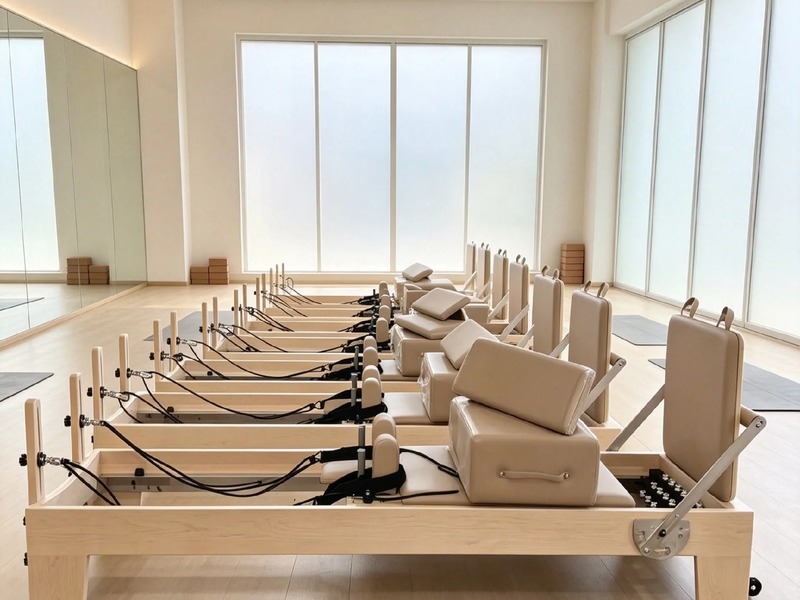
A new studio has one budget and a hundred demands on it. The reformer is usually the largest single line item, and it is also the hardest thing to change later. Choose badly and you are replacing equipment before your second year. Choose well and the same machine carries you from your first class through your first expansion.
This guide is written for owners opening a first location or fitting out a new room. It walks through the decisions in the order they actually matter: your studio model, the specs that survive daily class loads, how many units to order, what a machine really costs per client session, and the questions to put to a supplier before you sign anything.
Quick answer: how to choose a Pilates reformer for a new studio
Match four things to your class schedule first: daily run hours, client height and weight range, fixed or folding footprint, and long-term parts supply. For any machine that will run more than four hours a day, buy commercial grade — a full-length rail, replaceable springs with standard fittings, a 150–180 kg capacity rating, and a written frame warranty. Then confirm the price and lead time of a replacement spring set before you place the order, because springs are the one part you will definitely buy again.
Key takeaways for new studio owners
Buy commercial grade for any machine running more than 4 hours a day; home-grade units fail inside 12–18 months at that load.
Rail and carriage quality matters more than frame colour, finish, or brand badges. It is the cheapest thing to cut and the first thing clients notice.
Budget by cost per client session, not sticker price. A commercial reformer typically lands well under a home-grade unit once lifespan is included.
Springs are a consumable. Ask for the replacement price, lead time, and fittings standard in writing.
Order in phases. Launch with enough reformers to fill your largest class, then add a second bank when you add a second instructor.
Get weight capacity, maximum user height, and warranty coverage confirmed in writing before a bulk order.
Step 1: Start with your studio model, not the machine
The right reformer for a boutique reformer studio is not the right reformer for a 24-hour gym floor, even though the exercises are identical. Your business model sets the spec.
| Studio model | Typical setup | What the reformer must deliver |
|---|---|---|
| Boutique reformer studio | One room, 6–10 reformers, classes of 4–8, memberships | Whisper-quiet glide, premium feel, consistent spring calibration across every unit, visual finish |
| Fitness centre / multi-modality gym | Reformer is one station among many, high traffic, mixed supervision | Durability under 30–50 daily users, easy-clean upholstery, robust frame, low maintenance |
| Rehabilitation / clinical room | One-to-one sessions, graduated resistance, accessories in constant use | Fine spring gradation, 2-in-1 reformer-and-tower configuration, precise adjustability |
| Mobile / small-footprint studio | Shared or rented space, equipment stored between sessions | Folding design that stores vertically without losing rail length when open |
Write down which row you are in before you open a single supplier catalogue. A studio that trains memberships at 6 a.m. and 7 p.m. needs different springs from a clinic that runs gentle one-to-one work all afternoon.
Step 2: The seven specs that decide whether a reformer survives your schedule
These are the specifications that separate equipment that lasts from equipment that gets replaced. Read them as a checklist, not a spec sheet.
| Spec | What to check | Why it matters to a studio |
|---|---|---|
| 1. Rail and carriage glide | Full-length rail, sealed bearings or 8+ precision wheels, no lateral play | The cheapest place to cut corners and the first thing clients feel. A dragging carriage ends memberships. |
| 2. Spring system | 4–5 colour-coded springs, standard fittings, sold as a replaceable set | Springs are the component that actually fails. Non-standard fittings lock you into one supplier. |
| 3. Frame material | Hardwood (maple or oak) or aluminium alloy, joint construction | Sets the look, the weight, and how much daily abuse the machine absorbs. |
| 4. Weight capacity | 150–180 kg rated for commercial use, with written confirmation | Capacity is a safety and liability question, not a marketing number. |
| 5. Maximum user height | Confirm the frame length and whether extension kits exist | If your market skews tall, a short frame means turning clients away. |
| 6. Footbar and adjustment range | 3+ footbar positions, locking mechanism, quick gear change | Drives how fast a class flows and how many exercise variations you can teach. |
| 7. Upholstery and cleaning | Dense foam over a non-slip, wipe-clean cover; replaceable panels | Eight classes a day means sweat, sanitising spray, and worn foam within two years. |
Three of these deserve a longer look.
Rail and carriage glide
Sit on a carriage and push it. If it catches, rattles, or needs a nudge to start moving, your clients will feel that hesitation on every single repetition for the life of the machine. It is also the clearest indicator of whether a supplier invests in the parts you cannot see.
Springs are a consumable, not a lifetime part
Springs lose tension with cycle count. A studio machine running several sessions a day will go through spring sets on a predictable schedule, and a properly maintained reformer should never reach the point where a spring snaps mid-class. Before you order, ask three questions: what does a replacement set cost, how long does it take to arrive, and are the fittings a standard size. A cheaper machine with expensive or slow-to-source springs costs more over three years than a premium machine with stocked parts.
Weight capacity and maximum height
Studios see every body type. A 135 kg limit sounds generous until a taller client or a strength athlete walks in, and capacity sits directly on your insurance and liability position. Look for 150–180 kg on commercial models, and confirm the number in writing rather than reading it off a catalogue photo.
Step 3: Fixed or folding — the footprint decision
A standard studio reformer runs roughly 2.3–2.5 m long and about 0.8 m wide, and it needs around a metre of clear floor on the working sides. In a city where rent is charged by the square metre, that footprint is a recurring cost.
| Fixed reformer | Folding reformer | |
|---|---|---|
| Setup time between sessions | None | 30–60 seconds per unit |
| Floor space when idle | Permanent allocation | Stores vertically against a wall |
| Best for | Dedicated reformer rooms running back-to-back classes | Shared spaces, rented rooms, mobile trainers, small studios |
| Compromise to check | None, if the room is yours | Confirm rail length and glide quality stay identical when open |
The decision rule is simple. If the room belongs to you and runs a full timetable, buy fixed — you never want to lose time folding ten units between classes. If the space is shared, rented by the hour, or needs to serve another purpose in the evening, folding models buy you the flexibility to be in business at all.
Step 4: How many reformers does a new studio actually need?
The number is set by your largest simultaneous class, not by the size of the room.
Reformers needed = maximum clients training at the same time across all rooms.
Work through it in three moves:
Fix your class size. A boutique reformer class is typically 4–8 clients depending on room size and instructor attention.
Count simultaneous classes. One instructor means one class at a time. Adding a second instructor doubles your requirement instantly.
Add headroom. Keep one spare unit per ten in service so a machine out for servicing never costs you a booking.
A single-room studio running 6-client classes with one instructor needs 6 machines plus 1 spare — launch with 7, and plan the second bank of 6 for the day you hire your second instructor. Ordering 12 units on day one ties up capital in equipment that is empty twice a day.
Step 5: What a reformer really costs — price per client session
Sticker price tells you almost nothing. Cost per client session does, because it folds in lifespan, replacement cycles, and downtime.
| Home-grade unit | Commercial-grade unit | |
|---|---|---|
| Purchase price | $550 | $1,500 |
| Realistic service life under studio load | 12–18 months | 7–10 years |
| Units needed to cover 7 years | ~4.7 (about $2,585) | 1 ($1,500) |
| Unplanned downtime | Frequent, usually mid-timetable | Planned, scheduled between blocks |
| Sessions delivered over 7 years* | ~12,600 | ~12,600 |
| Cost per client session | ~$0.21 | ~$0.12 |
*Illustrative model. Assumes 6 sessions a day, 300 operating days a year, over a 7-year horizon. Substitute your own class count and the comparison holds: the commercial unit works out roughly 40% cheaper per session, before you count the revenue lost to a broken machine during a fully booked block.
The number that never appears on a quote is downtime. A reformer that fails during a sold-out Saturday morning costs you the class, the goodwill, and sometimes the membership.
Step 6: Frame material — maple, oak, or aluminium alloy
| Material | Strengths | Trade-offs | Best fit |
|---|---|---|---|
| Maple | Dense, stable, warm finish, excellent vibration damping | Heavier to move, needs humidity control | Premium boutique studios, flagship reformer rooms |
| Oak | Hard-wearing, strong grain character, slightly lower cost | Slightly less uniform than maple | Studios wanting a wood aesthetic at mid budget |
| Aluminium alloy | Lightest option, highest abuse tolerance, no humidity sensitivity | Cooler, more clinical look; less boutique feel | High-traffic gyms, warm or humid climates, mobile setups |
There is no single correct answer, and any supplier who tells you there is has a stock position to clear. Wood suits rooms where the atmosphere is part of the price you charge. Aluminium alloy suits rooms where the machine has to survive twenty strangers a day in a humid climate. Decide which of those two you are running, and the material chooses itself.
Step 7: Ten questions to ask a supplier before you sign
Send these in writing and keep the answers. They are the difference between a partner and a purchase order.
What is the frame warranty, in years, and does it cover commercial use?
What does a full replacement spring set cost, and what is the lead time?
Are the spring fittings a standard size, or proprietary to your factory?
Can you supply spare parts — wheels, straps, footbar hardware — for at least 7 years?
What is the rated weight capacity, and what is the maximum user height for this frame?
How is each unit inspected before shipment, and will you share the inspection checklist or report?
What is the warranty claim process — who covers return shipping, and how long does a replacement take?
If I add units in 12 months, is pricing locked, and can you match the finish exactly?
Do you offer OEM or ODM if I want my studio brand on the machine?
What is the production lead time in weeks, and what happens if units arrive damaged?
Questions 6 and 7 are the ones suppliers either answer quickly or avoid. Treat a vague answer as your answer.
Step 8: An eight-week buying timeline for a new studio
| Timing | Action |
|---|---|
| Week 1 | Confirm studio model, class size, and number of simultaneous classes. Fix your reformer count. |
| Week 2 | Measure the room properly — aisle space, working clearance, and the delivery route through doors and stairwells. |
| Week 2–3 | Request quotes from three suppliers against the same specification list. Compare like for like. |
| Week 3–4 | Bring in a sample unit. Have your instructors teach on it. Test glide, spring calibration, and setup time. |
| Week 4–5 | Negotiate warranty, spring supply terms, spare parts, and delivery schedule in writing. |
| Week 5–6 | Place the order. Confirm production lead time against your launch date — not the other way round. |
| Week 6–8 | Delivery, installation, instructor orientation, and a written spring-inspection schedule before your first class. |
Two of these rows get skipped and both cause problems. Measured delivery routes prevent the classic disaster of twenty reformers that will not fit through the door. A written spring-inspection schedule prevents the spring that snaps in front of a paying client.
Five mistakes that cost new studio owners the most
Buying home-grade equipment for a studio floor. It saves money at launch and costs more within 18 months, usually with downtime.
Choosing frame colour over rail quality. Aesthetics sell the room; the carriage glide keeps the member.
Ordering the full fleet before the first class sells out. Buy to fill your largest class, then expand against demand.
Ignoring the consumables budget. Springs, straps, and upholstery are recurring costs. Plan them from month one.
Skipping the sample trial. Ten minutes on a demo unit tells you more than any specification sheet.
Frequently asked questions
How many Pilates reformers do I need for a new studio?
Base the number on your largest simultaneous class, not your room size. A single-room boutique studio running 6-client classes needs 6 reformers, plus one spare so a machine out for servicing never costs you a booking. Every additional instructor running a class at the same time adds a full bank of machines.
Should I buy wood or aluminium reformers for my studio?
Wood — typically maple or oak — suits premium boutique rooms where atmosphere is part of your pricing. Aluminium alloy suits high-traffic gym floors, humid climates, and setups where machines are moved frequently, because it is lighter and less sensitive to humidity. Both can be commercial grade; the material is a business decision, not a quality tier.
How much floor space does each reformer need?
Plan for roughly 2.3–2.5 m long and 0.8 m wide per machine, plus about a metre of clear working space on each side for the instructor and client to move. A ten-reformer room needs far more than ten times the machine footprint once aisle space is included. Folding models reduce idle footprint, not working footprint.
How long does a commercial Pilates reformer last?
With basic maintenance, 7 to 10 years in a busy studio running several classes a day. Springs and carriage wheels are the parts you replace along the way; the frame and rails are built to outlast them. Home-grade units pushed into studio service typically need replacing inside 12 to 18 months.
Can I use a home reformer in a studio?
Only for very light use, and it is a risk. Home units are not built for daily class loads, their shorter warranty rarely covers commercial use, and their weight capacity typically tops out around 110–135 kg. Most studio insurance and equipment standards expect commercial-grade equipment.
Do I need a spring replacement budget?
Yes. Springs are a consumable part on any reformer and lose tension with cycle count. Confirm the price and lead time of a full replacement set before you order the machines, and set up an inspection interval — every few months on machines running multiple daily sessions — so replacement is scheduled, never an emergency.
What is a realistic budget for outfitting a new studio?
Budget per client session rather than in total. A commercial reformer in the $800–$2,500 range, working out over a 7-year life at 6 sessions a day, costs roughly $0.12 per client session. Multiply that by your projected session volume to get the equipment contribution to your membership pricing — and add a separate consumables line for springs, straps, and upholstery.
Fixed or folding reformer for a small studio?
Fixed if the room is yours and runs a full timetable, because folding costs setup time between every class. Folding if the space is shared, rented by the hour, or used for something else in the evening. Whatever you choose, confirm that rail length and glide quality are identical on the folding model when it is open — the fold should cost you floor space, not performance.
Where FitMax fits in
FitMax builds commercial-grade Pilates reformers in maple, oak, and aluminium alloy from a 20,000 m² facility in Wuxi, China, with 10 years of manufacturing experience and an annual output capacity of over 100,000 units exported to more than 50 markets. Beyond standard reformers, our range covers 2-in-1 reformers with tower, Cadillac beds, wunda chairs, and ladder barrels — and we run an OEM/ODM process from inquiry and 2D/3D design confirmation through sampling, mass production, and 100% pre-shipment inspection.
If you are sizing a fleet for a floor plan, our team will work through machine count, footprint, and delivery schedule with you and quote against your specification list. Start with the commercial Pilates reformer range, look at the Pilates studio solution, or contact us for a quote.
Conclusion
The reformer you choose in week five will be running your timetable in year seven. Decide your studio model first, then hold every supplier to the same specification list, then buy for cost per client session rather than sticker price. Order enough machines to fill your largest class, keep one spare, and lock down spring supply in writing. Do those four things and the equipment decision stops being the risk in your business plan.
Building a studio from scratch? Browse the full FitMax equipment range, or talk to our team about a fleet quote — we will help you match machine count and specification to your floor plan and launch date.